Published October 17, 2022 02:43PM
4 Deadlift Variations for Stronger Glutes
Bring your backside back to life with these four deadlift variations.
(Photo: Ian Spanier)
Today’s booty-crazed world has shifted the focus behind us, and we’re not complaining: Your posterior chain is a powerful partnership between glutes and hamstrings that propel you to faster sprints, bigger lifts and higher jumps. You’d be hard-pressed to find an exercise better than the deadlift to strengthen and shape your hams and glutes, but any exercise can get old after a while.
Use these deadlift variations to switch up your routine and master the all-important hip-hinge technique to create that sexy strength and power you need to lift some seriously heavy stuff — and of course fill in those jeans quite nicely, thank you very much.
Level 1: B-Stance Dumbbell Romanian Deadlift

This move is a great way to target one leg at a time, which can help reveal and then overcome strength imbalances. Since you still have the support of your “kickstand” (back) leg, you can go a little heavier without being limited by your ability to balance on a single ankle.
Hold a set of dumbbells in front of you and assume a split stance — one foot forward and one back — with your feet placed about hip-width apart. Shift most of your weight into your working (forward) leg, keeping your knee straight but soft. Your supporting (non-working) leg should be about a half a foot’s length behind you on your tiptoes, knee bent — like a kickstand for balance. Maintain a straight back as you fold forward and press your hips back to lower the weights, keeping them close to your thighs and bending your knee as you descend. Pull yourself back to standing with the backside of your working leg. Do all reps on one side, then switch.
ADVERTISEMENT
Troubleshooting
- You can hold the dumbbells in front of you or at your sides, but don’t let them drift too far forward, which can torque your lower back and sacroiliac joint.
- If your hamstrings are tight and you can’t properly hinge forward, your lower back might round, which puts your erector spinae and spine at risk. Prevent rounding — as well as shrugging or hunching — by engaging your upper back to lock your shoulder blades into place and lower down only as far as you can while maintaining a neutral spine.
- All the work should be focused on one leg while the other simply works to maintain balance. Shift your bodyweight forward and distribute it evenly throughout your entire foot to ensure your rear foot is mostly passive.
Level 2: Single-Leg Dumbbell Romanian Deadlift

Going from two legs to one adds a significant challenge to your balance and hip/ankle stability, so use a lighter weight than you would for the B-stance or another dumbbell variation.
Hold a set of dumbbells in front of you and stand with all your weight in your working leg, knee straight but soft. Extend the other leg straight behind you, toes pointed and touching the floor, and find your balance. Hinge at your hips to lower the weights, and as your torso goes down, your rear leg should rise behind you at the same pace. When your torso and leg are parallel to the floor, pause briefly and then use your hamstrings and glutes like a pulley to bring you back up. Do all reps on one side, then switch.
Troubleshooting
- Keep the dumbbells even on either side of your working leg and drop them straight down over the arch of your foot. If they drift too far out in front, you’ll be pitched onto your toes, compromising your lower back and balance.
- To target the posterior chain rather than your core, keep your hips level and square, and press the heel of your rear leg toward the wall behind you while driving that same-side hip toward the floor. You also can turn your back toe inward slightly to further engage your glutes.
- If you’re having issues with balance, do this move on a hard, flat surface with a well-fitting flat-soled shoe — or barefoot — for better stability.
ADVERTISEMENT
Level 3: Sumo Deadlift
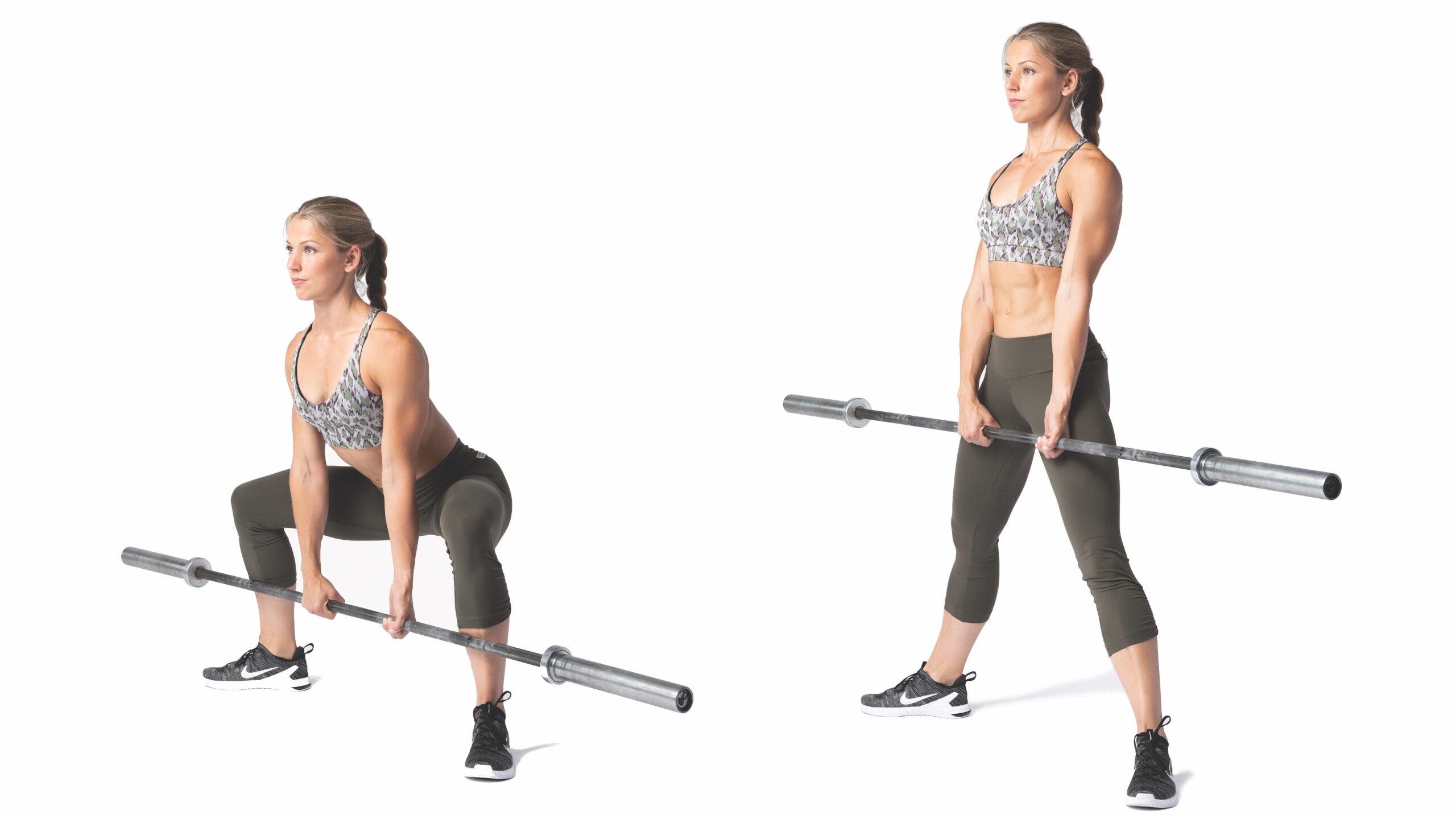
There’s no denying that you can pull more from the floor when in a sumo stance. Not only do you invite the inner-thigh muscles to join the team, but the external rotation of your hips and wider base of support also decrease the distance from the bar to your center of gravity, helping develop total-body pulling strength and force from a new angle.
Assume a wider-than-shoulder-width stance and turn your legs out from your hips. Drop your glutes straight down and bend your knees to take an overhand or alternating grip on the bar. Lift your chest, draw your shoulders back and inhale. Keep the barbell as close to your body as possible as you drive both feet into the floor and extend your hips and knees at the same rate to come to standing. Squeeze your glutes at the top and then reverse the steps to lower back to the floor.
ADVERTISEMENT
Troubleshooting
- Your feet do not have to point outward 180 degrees, and in fact, turning out too far can result in rotation in the lower leg, possibly twisting your knees. Initiate your turnout from your hips and find a range that you can maintain without allowing pain or compromising your form.
- If your knees tend to collapse inward, either decrease your degree of turnout and/or focus on driving your knees apart during the upward phase. You should be able to draw a straight line down from your patella to the second or third toe of your foot throughout the entire movement.
- The sumo deadlift doesn’t require as much of a hip hinge as a standard deadlift, so don’t initiate the move by pressing your hips back because this will force your hips to rise first and place the stress in your lower back. Instead, keep your torso tall and drop straight down, only bending at your hips to lower those last couple of inches down to grip the bar.
Level 4: Deficit Deadlift

The deficit deadlift is not for the faint of heart or tight of hamstring. Starting by standing a few inches above the floor is great for training the bottom of the pull to improve strength. It also can help further the range of motion and add value to the move for those who have really flexible hamstrings.
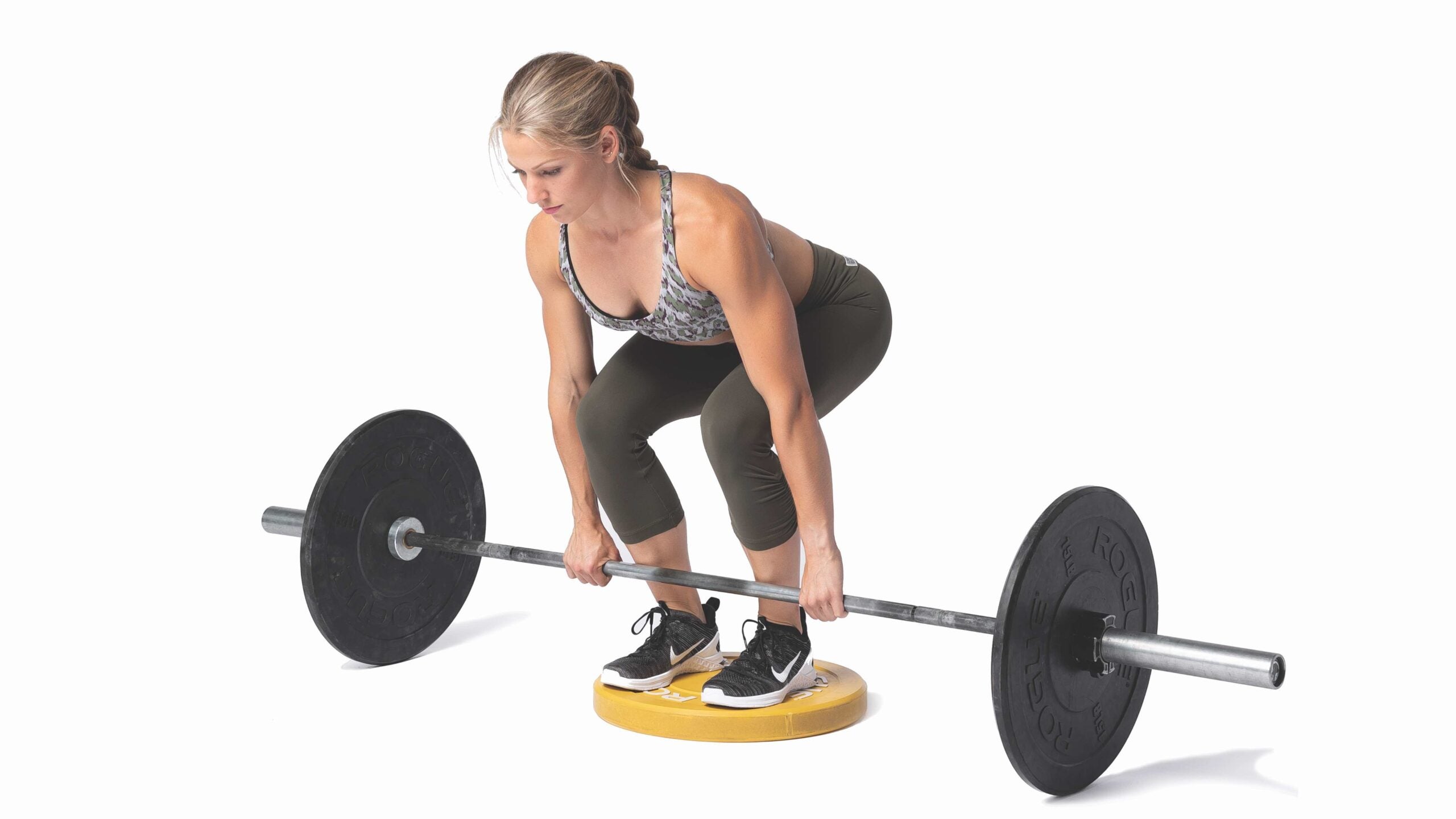
Stand on top of a bumper plate or block that is 1 to 4 inches high with your feet hip-width apart. Roll the bar so it’s right over your shoelaces, push your hips back and then take an overhand grip on the bar outside your knees. With a tight core, extend your knees and hips and pull the bar upward in a straight line close to your body to come to standing. Squeeze your glutes at the top and then do a controlled bar drop or perform an eccentric descent back to the start.
Troubleshooting
- If the bar swings too far forward, the line of pull shifts and you can pull your erector spinae or lower-back muscles. Make sure your shoulders are directly over the bar — not out in front — at the start, and engage your lats in the starting position to keep it close to your body.
- Deficit deadlifts can be done with a heavy load focusing on the concentric (pulling) action and a fast eccentric — or controlled drop — on the way down. But even if you’re training for hypertrophy and want to include more emphasis on a slower eccentric, the concentric portion can still be done at a moderate speed, about one or two counts up.
- If you’re using a naked bar or small plates — e.g., not 45’s or bumper plates — you won’t need to stand on an elevated surface. The purpose of a deficit is to put the starting position lower down your shin than a standard deadlift to give you extra range of motion.