Published February 16, 2022 03:11PM
3 Exercises to Improve Your Skiing
Become a better skier with these go-to exercises.
(Photo: Getty Images)
In sports-specific training, it doesn’t get much more efficient than exercises that serve as twofers, doing double duty by decreasing injury risk while improving your sports performance. In skiing, the top twofers may be predictable if you’re a veteran on the slopes — but ensuring you’re doing these moves properly can make or break your progress.
Whether you’re hitting the slopes for the first time or your 1,000th time, take a moment to incorporate some of these top twofer skiing exercises into your cross-training days.
Exercises to Improve Your Skiing
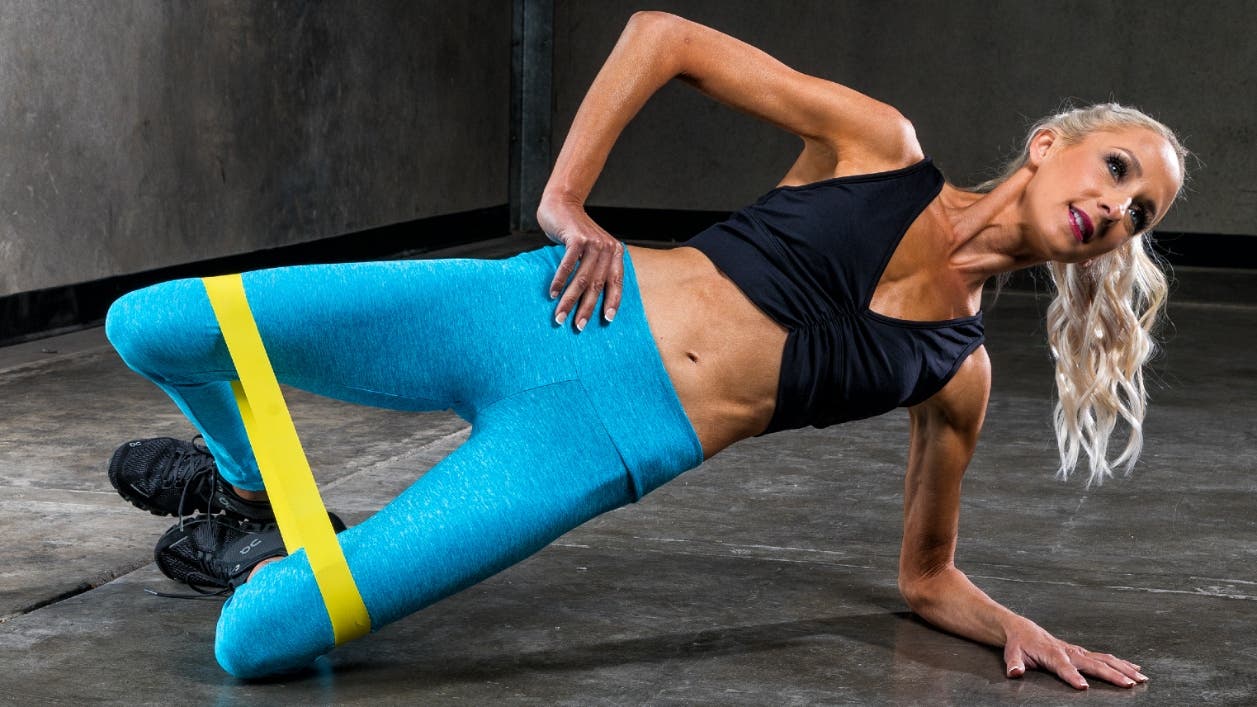
1. Side-Plank Clams
Pain on the front side of the hips and groin is a major problem that sidelines skiers. When your hips start pinching, you have to ski in a more upright position, which will compromise every element of your skiing technique. Often, this limitation is caused by overworking your front hip muscles. They compensate for weakness in the sides of your core and hips, but your core side muscles (like your gluteus medius and obliques) should be the ones to guide all of your ski direction changes.
While many skiers have tried clam exercises, they often perform them incorrectly. They bend their knees and hips to approximately 90 degrees — a technique error that overworks the fronts of the hips and decreases the work done by the gluteus medius. This is the exact opposite of what you want.
ADVERTISEMENT
Instead, fix your alignment and increase core strength by doing side knee plank clams instead.
How-to:
- Start in a side plank on your knees. Make sure your supporting elbow is directly under your shoulder, and your thighs form a straight line with your torso.
- Engage your core so you are not arching your low back.
- Consciously squeeze your glute muscles and rotate your top knee toward the ceiling. Allow your feet to maintain inner edge contact with each other.
- Try to hold your end position for 5 seconds before bringing your knee back down.
Perform these with a goal of working up to three sets of 20 reps on each side. Be patient, as building this kind of endurance takes time.
Advance the exercise further by adding a very light band just above your knees. Note: Stronger bands are not better. You know your band is too heavy if the band limits your range of motion.
2. Bridge Marches
As most lifters know, the gluteus maximus takes up all of the real estate on the hips’ backside. This powerful muscle often gets inhibited because we sit on it during the day. Therefore, skiing without activating your glutes can put stress your knees and low back, leading to injury or a plateau in your technique development.
While skiing may seem like an activity performed on two legs, it’s actually a continuous weight shift between legs. If one side is stronger than the other, imbalances in both your technique and knee safety result. The bridge march not only activates the essential glutes, but also helps decrease the right versus left hip muscle imbalances.
ADVERTISEMENT
How-to:
- Begin laying on your back with your knees bent to approximately 90 degrees.
- Pull your abs in to prevent your back from arching. Keep your core tight the entire time.
- Consciously squeeze your glutes before you move.
- Now that your glutes are squeezed, raise your hips off the floor. More is not necessarily better. Only go to a height that you can maintain without your back or hamstrings cramping.
- If you’re getting hamstring or back cramps, it’s because they are substituting for your glutes. Work on achieving any height of hip bridge without cramping before attempting to progress. Then work up to three sets of 20 hip bridges before adding the next step.
- Once you’re able to perform three sets of 20 bridges without cramping, progress to the bridge march. At the top of your bridge, focus on keeping your hips perfectly level. Squeeze your right glute extra hard as you lift your left foot only 2 inches off the floor; higher is not better! Hold for 3-5 seconds, then put your left foot back down. Stay in your bridge as you switch to the other side.
Work up to three sets of 20 bridge marches without allowing your pelvis to rotate or your hamstrings to cramp. Resist the temptation to add bands or weights to this exercise. If you’re properly activating the glutes and keeping your pelvis completely stable, three sets of 20 will take you a few months to achieve.
3. Front Squats
Ever wake up after a day on the slopes with your quads feeling so sore that you don’t want to walk? This is a common feeling, especially if you’re a new skier or are trying to increase your skill level. After all, your quads are responsible for holding your knees strong on every single run, and this demands great strength and endurance. The barbell front squat emphasizes the needed quad strength and endurance.
How-to:
- If front squats are new for you, practice with a dowel rod to get the technique. Then progress to an unloaded practice barbell (15 pounds), before adding heavier weights. If you’re experienced with back squats, start with an unloaded barbell to master technique. As you progress, front squats are typically loaded at 70-85% of your back squat load.
- Start with your feet shoulder width apart and toes angled slightly outward (about 10-15 degrees).
- When you’re using a barbell, the backs of your hands go as close to the top of each shoulder as possible. Your elbows should be pointed straight forward.
- Keep your heels, big toes, and little toes on the floor throughout the squat.
- Tighten your core as your hips move down and back. Your knees stay aligned with your toes, just as they do in a back squat. Be sure to keep your gaze forward. Only go as low as you can without rounding your back.
- At the bottom of the lift, engage your glutes and use them to boost you back up to your starting position.
- Do your heavy set first for 5-6 reps, then superset with a light load for 10-20 reps. If supersets are new, start with one set. Over the next few weeks, work up to 3-4 sets.
Once a week, try doing front squat supersets. Do your first set at a heavy load that you can perform for only 5-6 reps while maintaining form. Then, switch to a light weight where you can perform 10-20 reps until fatigue.
ADVERTISEMENT
If you don’t have access to a barbell (or if front squats are new for you), do goblet squats with a dumbbell in front of your chest instead. Resist the temptation to try this on a Smith machine. The Smith machine changes your alignment, and this can present a knee injury risk.
Next Steps
Your capacity to develop technique and progress skiing levels depends on your underlying muscle endurance and strength, so take a moment to plan the side plank clam, bridge march, and front squat supersets into your leg cross-training day.
Stay attentive to the details shared in this article, as intentional movement, sets, and reps change the outcome. Prepare to step up to the challenge that these skiing twofers present as they build your capacity for your next skill milestones on the slopes.